The legal AI landscape in 2026 looks nothing like it did even two years ago. What started as basic document search and contract review tools has evolved into a sophisticated ecosystem of AI-powered platforms, each promising to transform how law firms operate. For managing partners and legal operations leaders, choosing the right AI platform is no longer optional—it is a strategic imperative that will define their firm's competitiveness for the decade ahead.
Three platforms dominate the conversation today: Harvey, Legora, and Lexi. Each tackles the problem from a fundamentally different angle. Harvey builds for the elite; Legora streamlines collaboration; and Lexi is redefining what a full-stack legal AI system can deliver for the firms that make up the vast majority of the legal market. Understanding the differences between these tools—and which one fits your firm—requires a closer look at what each brings to the table.
In this comprehensive comparison, we break down Harvey vs Legora vs Lexi across pricing, features, target firm size, integrations, and more. Whether you are an Am Law 100 partner evaluating enterprise AI or a 15-attorney firm looking for Harvey AI alternatives, this guide will help you make an informed decision.
Harvey AI: Enterprise Power for BigLaw
Overview and Market Position
Harvey is built for the world's largest law firms. Backed by significant venture capital and partnerships with firms like Allen & Overy (now A&O Shearman), Harvey has positioned itself as the AI platform of choice for Am Law 100 firms. Its focus is depth, not reach—LLM-powered legal research, document generation, and complex custom workflows for firms with thousands of lawyers.
Harvey's approach is uncompromising: build the most powerful legal AI possible, then deploy it within enterprise environments that can support its complexity. The result is a platform that delivers impressive results for the firms that can afford it and have the technical infrastructure to run it.
Core Capabilities
Harvey's feature set is tailored for high-stakes, high-volume legal work. Key capabilities include:
Advanced legal research: Harvey leverages custom large language models fine-tuned on legal corpora. It can analyze case law, statutes, and regulatory frameworks across multiple jurisdictions with remarkable depth.
Document generation and review: From drafting complex transactional documents to reviewing thousands of contracts during due diligence, Harvey handles document-heavy workflows that would take human teams weeks.
Custom workflow automation: Harvey's enterprise clients can build bespoke AI workflows that mirror their existing processes—meaning the platform adapts to the firm, not the other way around.
Knowledge management: Harvey can be trained on a firm's proprietary work product, precedent banks, and internal guidelines, creating a firm-specific AI that reflects institutional knowledge.
Pricing and Accessibility
Harvey's pricing reflects its enterprise positioning. Industry estimates place Harvey's annual cost at approximately $288,000 per year for a full firm deployment—a figure that includes licensing, onboarding, customization, and ongoing support. For a firm generating hundreds of millions in annual revenue, this is a rounding error. For a 20-attorney firm, it is a non-starter.
The implementation timeline is equally enterprise-grade. Deploying Harvey typically requires months of data integration, security reviews, and custom configuration. Firms need dedicated IT resources and often a project manager to oversee the rollout.
Strengths and Limitations
Harvey's strengths are clear: unmatched depth for complex legal work, strong security posture for enterprise environments, and the ability to customize at scale. However, these strengths come with trade-offs that matter for the majority of law firms:
High cost of entry: At ~$288K/year, Harvey is priced for BigLaw budgets only.
Long implementation cycles: Expect 3–6 months before the platform is fully operational.
Requires internal technical resources: Smaller firms without dedicated IT teams will struggle with deployment and maintenance.
Limited small-firm features: Harvey does not prioritize workflows common in smaller practices, such as client intake automation, billing integration, or solo-practitioner dashboards.
Legora: Collaboration-First Legal AI
Overview and Market Position
Legora takes a different approach entirely. Rather than building a monolithic enterprise platform, Legora focuses on making legal collaboration smarter and faster. It integrates directly into the tools lawyers already use—Microsoft Word and Outlook—making adoption frictionless for mid-sized firms and corporate legal departments.
Legora's philosophy is pragmatic: meet lawyers where they are, rather than asking them to learn a new system. This approach has earned it a loyal following among firms that value incremental improvement over wholesale transformation.
Core Capabilities
Legora's feature set centers on document collaboration and review:
In-document AI assistance: Legora embeds directly into Word, offering real-time suggestions, clause analysis, and drafting assistance without leaving the document.
Collaborative review workflows: Multiple team members can review, comment, and approve documents within a structured workflow, reducing version-control chaos.
Due diligence automation: Legora accelerates due-diligence review by flagging key clauses, risks, and anomalies across document sets.
Clean user interface: Legora's UI is consistently praised for its simplicity. Lawyers who are skeptical of AI find Legora approachable and intuitive.
Strengths and Limitations
Legora excels at what it does. Its clean integration with Microsoft Office, focus on collaboration, and approachable learning curve make it a strong choice for firms that want to improve document workflows without disrupting their practice. Its pricing is more accessible than Harvey's, and onboarding is measured in days rather than months.
Still, Legora—like most legal AI tools—sits in a single lane. It is excellent at document review and due-diligence tasks, but it is not designed to automate the entire legal lifecycle. Firms that need AI to handle client intake, legal research, case management, court filing preparation, and analytics will find Legora covers only a portion of their needs. The result is that many Legora users end up supplementing it with additional tools, creating the very tool fragmentation they were trying to avoid.
Lexi: The Full-Stack AI Associate for Growing Firms
Overview and Market Position
That is where Lexi steps in. If Harvey is power for the elite and Legora is collaboration for the organized, Lexi is the full-stack legal AI for everyone else—especially the 2-to-200-attorney firms and in-house legal teams that need speed, scale, and automation without the enterprise overhead.
Lexi is not just a point tool; it is a platform. Built from the ground up to serve the firms that make up 95% of the legal market, Lexi delivers enterprise-grade AI capability at a price point and implementation timeline that makes sense for growing practices.
Core Capabilities
Lexi covers the entire legal workflow journey, replacing the need for multiple point solutions:
Client intake and triage: Automated intake forms, conflict checks, and matter opening—reducing administrative overhead from day one.
Legal research and precedent discovery: Powered by a knowledge base of 135,000+ legal documents and 7,000+ case precedents, Lexi delivers research results with cited sources and relevance scoring.
Contract review and analysis: AI-powered clause extraction, risk flagging, and comparison against standard terms—at speeds that turn days of review into minutes.
Drafting and template automation: Lexi generates first drafts from firm-specific templates, learning your preferred language, formatting, and clause libraries over time.
Case chronology and task management: Automatic timeline generation from case documents, with integrated task tracking that keeps matters on schedule.
Real-time analytics and reporting: Dashboards that surface matter status, team workload, and performance metrics without manual data entry.
Learns Your Firm's Standards
One of Lexi's most distinctive capabilities is its ability to learn and adapt to your firm's specific standards. Unlike generic AI tools that produce one-size-fits-all outputs, Lexi studies your precedent documents, preferred clause language, formatting conventions, and communication style. Over time, Lexi's drafts and suggestions become indistinguishable from work product your senior associates would produce.
This learning capability means that Lexi improves with every document your firm creates. New associates benefit from institutional knowledge captured in Lexi's models, and partners spend less time redlining AI-generated drafts because the output already reflects firm standards.
Integrations That Meet You Where You Work
Lexi integrates seamlessly with the tools legal professionals already use daily:
Microsoft Word: Draft, review, and revise documents with Lexi's AI assistance directly within Word.
Microsoft Outlook: Manage client communications, extract action items, and auto-populate matter details from email threads.
Google Docs: Full support for firms that run on Google Workspace, with the same AI capabilities available in the Google ecosystem.
iManage: Deep integration with iManage document management, allowing Lexi to access, analyze, and organize documents within your existing DMS.
Security and Compliance
Legal data demands the highest level of security. Lexi is ISO 27001 certified, meaning its information security management system has been independently audited and verified against international standards. Client data is encrypted at rest and in transit, access controls are granular and role-based, and Lexi maintains comprehensive audit logs for compliance purposes.
For firms subject to regulatory requirements—whether in financial services, healthcare, or government contracting—Lexi's security posture provides the assurance needed to deploy AI with confidence.
Agentic AI: Beyond Chat-Based Assistance
Behind the scenes, Lexi runs on agentic AI workflows—specialized legal AI agents that do not just answer prompts but act autonomously, completing multi-step legal tasks from start to finish. Ask Lexi to prepare a case summary, and it will pull relevant documents, extract key facts, build a chronology, identify legal issues, and produce a formatted brief—all without further prompting.
This agentic approach is what separates Lexi from chatbot-style legal AI. Rather than requiring lawyers to break complex tasks into individual prompts, Lexi understands the end goal and works backward to determine the steps needed to get there.
Why Full-Stack Matters
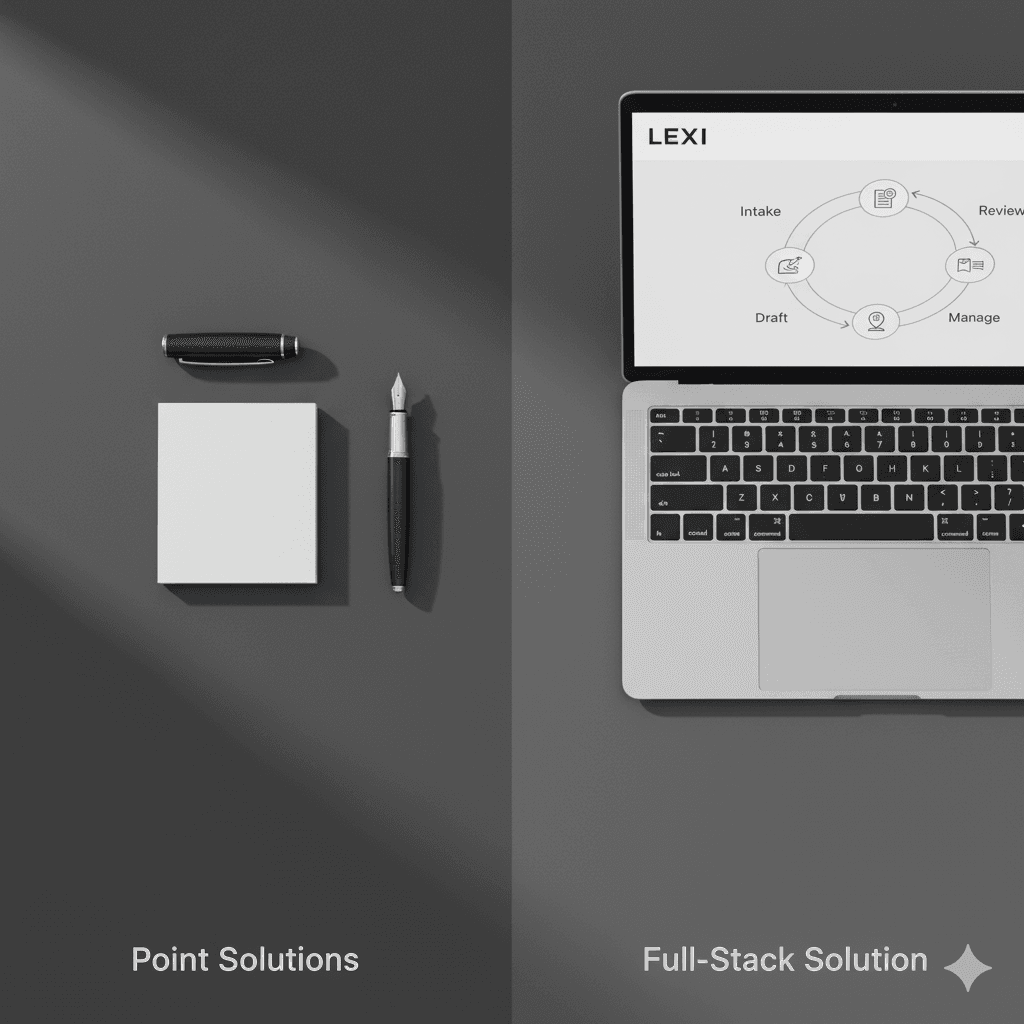
Point tools—like standalone contract review platforms or research assistants—help with fragments of legal work. But today's lawyers do not need fragments; they need flow. Lexi's full-stack design means every workflow is connected. Intake data feeds into drafting. Drafts sync with case timelines. Chronologies auto-generate briefs. Research results populate motion templates.
The result: no copy-pasting, no tool-switching, no lost context. Every piece of information entered into Lexi once is available everywhere it is needed. This eliminates the hidden tax of context-switching that costs lawyers an estimated 20–30% of their productive time each day.
Head-to-Head Comparison: Harvey vs Legora vs Lexi
| Feature | Harvey | Legora | Lexi |
|---|---|---|---|
| Target Firm Size | Am Law 100 / 500+ attorneys | Mid-size firms / Corporate legal | 2–200 attorneys / In-house teams |
| Pricing | ~$288K/year (enterprise) | Mid-range (per-seat) | Affordable per-seat plans |
| Key Features | Research, drafting, custom workflows | Document review, collaboration, due diligence | Full-stack: intake, research, drafting, case management, analytics |
| Integrations | Custom enterprise integrations | Word, Outlook | Word, Outlook, Google Docs, iManage |
| Learning Capability | Firm-trained models (enterprise setup) | Limited personalization | Learns firm standards, clause preferences, and style |
| Security Certifications | Enterprise-grade (SOC 2) | Standard encryption | ISO 27001 certified |
| Knowledge Base | Firm-specific training data | General legal data | 135K+ documents, 7K+ cases |
| Implementation Time | 3–6 months | Days to weeks | Days |
| AI Approach | Custom LLMs for legal tasks | AI-assisted document workflows | Agentic AI (autonomous multi-step tasks) |
Which Tool Is Right for Your Firm?
The right legal AI platform depends on your firm's size, budget, technical infrastructure, and strategic priorities. Here is a practical decision framework:
Choose Harvey if:
You are an Am Law 100 or Am Law 200 firm with 500+ attorneys.
Your annual technology budget can accommodate ~$288K/year for a single AI platform.
You have a dedicated legal technology or innovation team to manage deployment.
Your primary need is deep, custom AI for complex transactional or litigation work.
You are willing to invest 3–6 months in implementation before seeing full ROI.
Choose Legora if:
You are a mid-sized firm or corporate legal department focused primarily on document collaboration.
Your team lives in Microsoft Word and Outlook and wants AI embedded directly in those tools.
You need a quick-to-deploy solution for document review and due-diligence workflows.
You are comfortable using additional tools for research, intake, case management, and analytics.
Choose Lexi if:
You are a firm with 2–200 attorneys or an in-house legal team looking for a single platform that covers the entire legal workflow.
You want AI that learns your firm's specific standards, not just generic legal output.
You need integrations with Word, Outlook, Google Docs, and iManage—not just one ecosystem.
You value security and need ISO 27001 certification for compliance requirements.
You want enterprise-grade capability without enterprise-grade pricing or implementation timelines.
You are looking for a true AI associate, not just an AI assistant—something that can autonomously complete multi-step legal tasks.
Frequently Asked Questions
Is Harvey AI worth the cost for a mid-size firm?
For most mid-size firms (under 200 attorneys), Harvey's pricing and implementation requirements make it difficult to justify. At approximately $288,000 per year, the per-attorney cost for a 50-person firm is dramatically higher than for a 2,000-person firm. Mid-size firms typically get better value from platforms like Lexi that are purpose-built for their scale and offer comparable AI capabilities at a fraction of the cost. If you are evaluating Harvey AI alternatives, Lexi is worth a close look.
Can Lexi replace multiple legal tech tools?
Yes. Lexi's full-stack approach is specifically designed to replace the patchwork of point solutions that most firms rely on today. Rather than paying separately for research tools, contract review software, intake systems, and case management platforms, Lexi consolidates these capabilities into a single, connected platform. Firms that switch to Lexi typically retire 3–5 standalone tools in the process.
How does Lexi handle data security and client confidentiality?
Lexi is ISO 27001 certified, which means its entire information security management system has been audited by an independent third party and meets international standards. All data is encrypted at rest and in transit. Access controls are role-based and granular, ensuring that attorneys only see matters they are authorized to access. Lexi maintains comprehensive audit logs and does not use client data to train models for other firms. Learn more on our security page.
How long does it take to get started with Lexi?
Most firms are fully operational on Lexi within days, not months. The onboarding process includes connecting your existing tools (Word, Outlook, Google Docs, or iManage), uploading your precedent documents and templates, and a brief training session for your team. Lexi's learning engine begins adapting to your firm's standards immediately, with noticeable improvements in output quality within the first two weeks of use.
The Bottom Line
Legal AI is no longer about having a smarter assistant—it is about having a connected, autonomous system that scales your entire practice. The question is no longer whether to adopt AI, but which platform matches your firm's reality.
Harvey made AI usable for global firms—and it remains the best choice for the largest practices with the budgets and infrastructure to match.
Legora made legal AI collaborative for growing teams—and it is a solid option for firms whose primary need is document review workflows.
Lexi makes AI full-stack and accessible for the firms that drive the legal industry—the 2-to-200-attorney practices and in-house teams that need everything from intake to analytics in one platform.
The future of legal work will not be defined by individual tools. It will be defined by systems that think, act, and deliver like your best associate. For the vast majority of law firms, that system is Lexi.