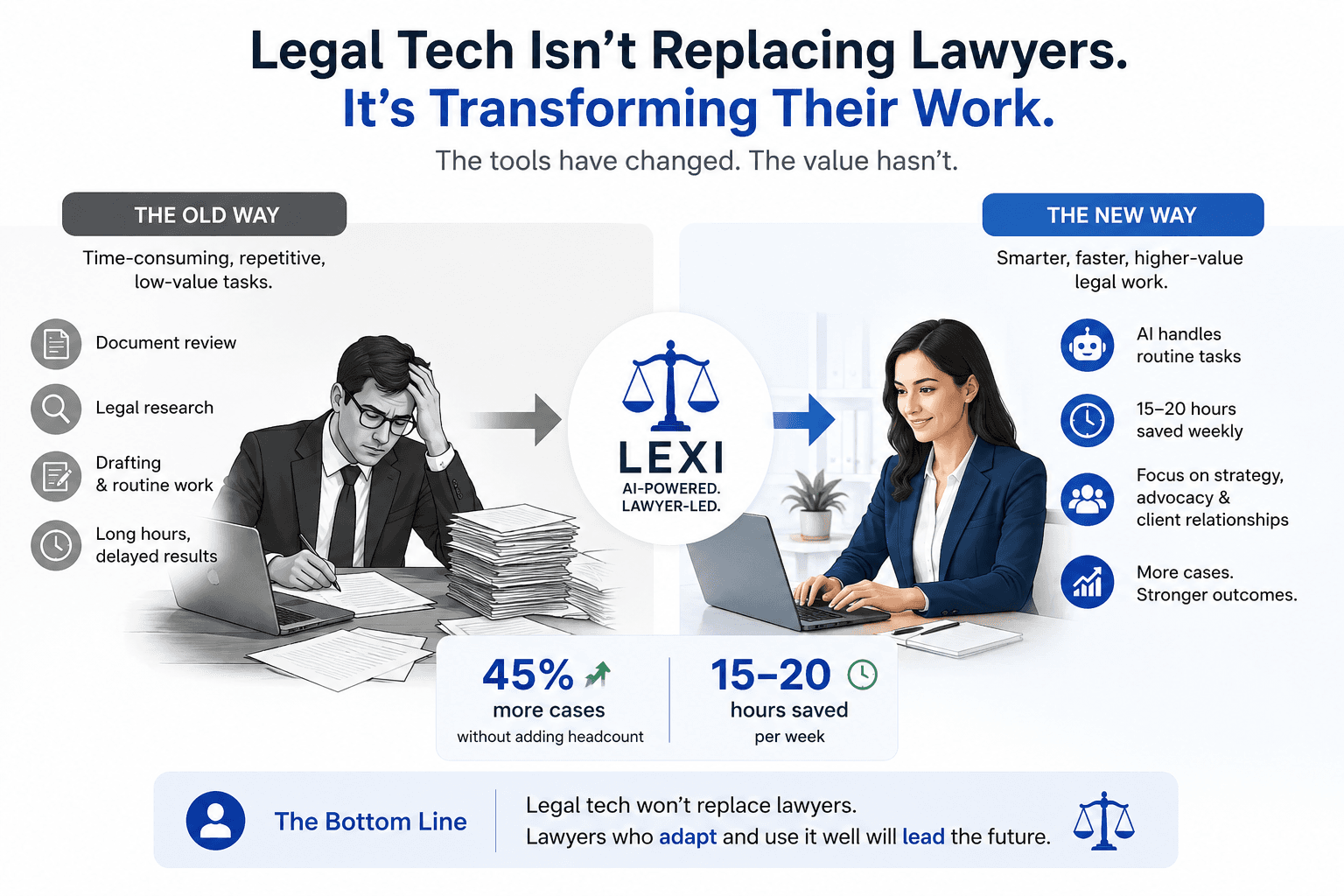
The short answer is no: legal tech is not replacing law firm jobs in a clean one-for-one way. In many jurisdictions, it is changing how legal work gets done by automating parts of the workflow, reducing repetitive manual effort, and increasing the value of skills such as verification, supervision, client communication, and judgment.
That is the clearest way to understand the debate around legal tech jobs vs law firm jobs. The real shift is not that lawyers disappear. It is that firms hire, train, and evaluate lawyers differently when first drafts, summaries, timelines, and document review can be accelerated with software.
At Lexi, we see that shift directly across firms and legal teams using AI for drafting, review, research support, timelines, and file organization. Across more than 200 organizations using Lexi, the platform has processed 5,000,000+ documents and supported work across 200,000+ cases. Customers report outcomes such as 45% more cases per attorney and 10+ hours saved per lawyer per week. These results suggest that, in practice, AI often expands capacity rather than replacing lawyers outright.
Why this is a spotlight on role redesign, not job extinction
This topic matters because the most misleading version of the conversation treats technology and law firms as opposing camps. In practice, the more important question is which legal tasks become faster, which responsibilities stay stubbornly human, and which new roles appear around the workflow.
That makes this less of a replacement story and more of a spotlight on role redesign. Legal teams still need lawyers to interpret facts, advise clients, negotiate positions, and stand behind the final work product. What changes is how much time gets spent reaching that point.
For a wider view of that transition, see how AI is changing the legal profession.
What is actually changing inside law firm work
Some work that once absorbed large amounts of junior time is now faster. First-pass contract review, document summarization, chronology building, issue clustering, and research organization can often be completed in far less time with the right systems. In practice, that affects three things: staffing models, client turnaround expectations, and how firms train junior lawyers.
That does not make the work unimportant. It changes where lawyers add the most visible value. As more routine production gets compressed, firms increasingly expect lawyers to focus on tasks like these:
- refining arguments rather than only collecting source material
- reviewing AI-assisted drafts instead of starting every document from a blank page
- advising clients on legal risk, tradeoffs, and business context
- making defensible judgment calls when facts are incomplete or disputed
- supervising confidentiality, quality control, and citation checking
This is also why early-career training needs attention. Routine assignments have long been part of how junior lawyers learn. If firms automate parts of that layer, they need stronger supervision and better teaching around judgment. Related concerns also appear in will lawyers become obsolete because of AI.
Why new legal tech roles keep appearing
As firms adopt more software, they often create or expand roles around the legal workflow. Common examples include legal operations, knowledge management, innovation, litigation support, product counsel, AI governance, and legal engineering. Titles vary across markets, but the pattern is similar: technology changes the mix of legal work and creates demand for people who can make delivery more efficient, safe, and scalable.
That is why the phrase legal tech jobs vs law firm jobs can be too narrow. In many teams, legal technology work becomes part of law firm work rather than an alternative to it. A practicing lawyer may help select tools, define internal standards, train colleagues, or design review workflows while still doing client-facing legal work.
For junior lawyers especially, this means relevance does not depend on becoming a programmer. It depends on learning how legal reasoning, process design, and professional responsibility interact. A practical starting point is AI for junior lawyers: practical ways to work faster without losing judgment.
The skills that become more valuable as automation grows
The lawyers who benefit most from AI-assisted workflows are usually not the ones using the most technical language. They are the ones who can define the task clearly, test the output properly, and connect the result to a real legal objective. In other words, software increases the premium on disciplined judgment.
- Instruction quality: giving clear, scoped directions and defining the deliverable properly
- Verification discipline: checking facts, authorities, dates, citations, and clauses before relying on output
- Risk judgment: knowing when a fast draft is helpful and when deeper review is essential
- Client communication: translating legal complexity into practical advice
- Workflow design: choosing when to use drafting, review, summarization, search, or timeline tools and when human-only handling is safer
These are not abstract future skills. They are becoming daily operating skills in many firms and legal departments. For a practical framework, see how lawyers can use AI safely: a 5-step checklist.
Why verification remains non-negotiable
Any credible discussion about legal employment and AI has to deal with reliability. Lawyers are not paid only to produce text quickly. They are paid to stand behind the work. That is why generated output cannot be treated as self-verifying.
One widely reported U.S. example is Mata v. Avianca (S.D.N.Y., 2023), where a filing cited non-existent cases generated by AI. The takeaway is not that AI tools are unusable; it is that lawyers cannot outsource verification. In any jurisdiction, the professional responsible for the final work product should confirm authorities, facts, and citations before relying on them.
That caution also aligns with bar and court guidance in many jurisdictions, which generally focuses on competence, confidentiality, supervision, and accuracy rather than blanket bans. If you want a deeper look at reliability, read is AI-generated legal work reliable and how accurate AI legal document review is.
What clients are really paying for now
Clients still pay for lawyers, but they are increasingly less willing to pay premium rates for avoidable friction. Many clients expect faster turnaround, more transparency, and clearer explanations of how legal work is being done. Technology helps firms meet those expectations, but it does not remove the need for a human professional who owns the advice and the result.
That is especially visible in teams under pressure to do more without adding headcount at the same pace as demand. AI-assisted workflows are growing in in-house legal teams as well as law firm environments because speed and consistency increasingly matter alongside legal quality.
As drafting tools become easier to access, the differentiator is not who can produce text the fastest. It is who can deliver a reliable outcome, explain risk clearly, and make judgment calls that a client can trust.
What this means for legal careers and legal education
Legal education in many jurisdictions was built for a workflow where research, review, and drafting were slower and more manual. That foundation still matters, but career planning now benefits from a wider lens. Lawyers entering the profession need more than doctrinal strength. They need habits for reviewing machine-assisted work without surrendering professional responsibility.
Future-ready lawyers should learn how to:
- use AI-assisted tools without treating them as autonomous experts
- review generated work product for factual and legal reliability
- protect confidentiality, privilege, and sensitive client information
- understand local bar, court, employer, or client rules on technology use
- collaborate effectively with operations, knowledge, and product teams
If you are building that muscle now, how to get started with legal AI is a practical next step.
A practical spotlight on how Lexi fits into the shift
Our view is straightforward: legal teams perform best when technology removes avoidable friction but lawyers retain control over judgment, advice, and final sign-off.
Lexi helps teams draft in their own style, review and redline contracts, organize case materials, and work with verified citations so lawyers can spend more time on analysis and less time on repetitive production. That applies across corporate legal work and litigation workflows, where the operational challenge is often not lack of legal talent but lack of time and process capacity.
Across more than 200 organizations using Lexi, the platform has processed 5,000,000+ documents and supported work across 200,000+ cases. Customers report outcomes such as 45% more cases per attorney and 10+ hours saved per lawyer per week. Read carefully, those figures do not prove a universal labor-market rule; they do show why many teams use AI to increase capacity, improve responsiveness, and reduce low-value manual work.
The bottom line
No. Legal tech is not replacing law firm jobs in a clean one-for-one way. It is redistributing legal work, compressing routine tasks, and increasing the value of lawyers who can combine speed with judgment.
The lawyers most likely to thrive are not the ones who reject these tools outright, and not the ones who trust them blindly. They are the ones who learn where technology helps, where it introduces risk, and where human accountability still matters most.
So the better question is not whether legal tech jobs will defeat law firm jobs. It is whether lawyers and firms will adapt quickly enough to use technology well while keeping professional standards intact.
FAQ
Will legal tech eliminate junior lawyer jobs?
Not universally. In many firms, it reduces time spent on repetitive tasks but increases the need for juniors who can review output carefully, learn faster, and develop judgment under supervision.
Are legal tech careers a good option for lawyers?
Yes. Many lawyers move into or work alongside legal operations, innovation, knowledge management, AI governance, and workflow design roles. Those paths often build on legal training rather than replacing it.
How can lawyers use legal tech without increasing legal risk?
Use tools to accelerate drafting, review, summarization, and organization, but verify the output before relying on it. Check local bar rules, court guidance, client obligations, and employer policies, especially when confidentiality or filings are involved.